Condition Based Maintenance Workshops
Article written byuser▼
in the categoryCBM Workshops▼
Why Practical CBM Workshops Can Change the Way Maintenance Teams Think
Condition-Based Maintenance can only deliver its full value when the people responsible for maintaining equipment understand why it is being carried out, how it works and what it can do for them.
Maintenance technicians are practical people. They work on equipment every day, deal with breakdowns and see first-hand what works and what doesn't.
Their experience of CBM can vary considerably. Some may have seen excellent examples where early detection prevented a failure. Others may have experienced machines failing despite being monitored, recommendations that didn't match what was eventually found, or reports that appeared to have little connection with the maintenance work being carried out.
These experiences naturally influence how people view CBM.
Simply telling people that CBM is valuable is unlikely to change that.
Giving them the opportunity to understand how and why it works can.
That is one of the main purposes of our practical Condition-Based Maintenance Workshops.
A Workshop, Not a Technical Training Course
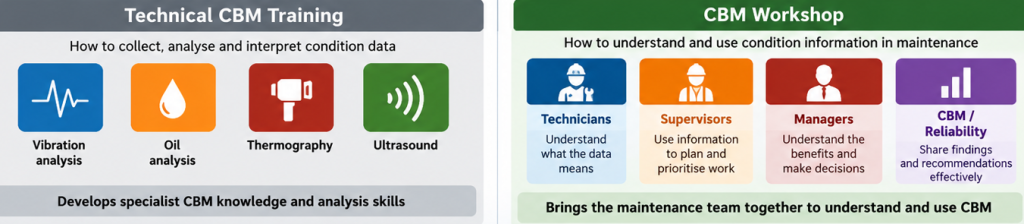
The workshops are not intended to turn maintenance technicians, supervisors or managers into vibration analysts.
There are excellent accredited training courses available for people who need specialist knowledge in vibration analysis, oil analysis, thermography and ultrasound.
Our workshops have a different purpose.
They are designed to bring maintenance people together and explain CBM in practical maintenance terms:
Why machines fail.
How defects develop.
What indications may be present before failure.
How CBM can identify those changes.
What should happen after deterioration has been identified.
Most importantly, we discuss how that information can help the maintenance team do its job more effectively.
Building Understanding Through Practical Examples
People are much more likely to engage with CBM when they can relate it to equipment and situations they recognise.
Rather than concentrating on technical theory, the workshops use real-world case studies and practical examples to look at how machinery condition changes and what those changes mean from a maintenance perspective.
For example:
What was the first indication that something was changing?
What did the condition information tell us?
What was eventually found when the machine was inspected?
Could the problem have been identified earlier?
Was maintenance carried out at the right time?
Could the machine safely have continued operating until a better maintenance opportunity?
What could be done differently next time?
Delegates are encouraged to question the examples, discuss their own experiences and contribute their knowledge of machinery and maintenance.
That is an important part of the workshop.
CBM isn't infallible.
Data can be poor. Measurements can be missed. Diagnoses can be wrong and recommendations can sometimes be inappropriate.
Understanding both the capabilities and the limitations of CBM helps people make better use of the information it provides.
Connecting CBM With the Maintenance Job
One of the most important outcomes from the workshop is connecting condition information with what maintenance teams actually have to do.
Finding a bearing defect isn't the objective.
The value comes from what that early warning allows the organisation to do.
If deterioration is identified sufficiently early, the maintenance team may have time to:
- Assess whether the machine can safely continue operating.
- Increase monitoring while the machine remains in service.
- Obtain the correct bearing, seals and other spares.
- Arrange technicians, specialist support, lifting equipment or scaffolding.
- Prepare the work order.
- Coordinate the intervention with operations.
- Take advantage of a planned shutdown or production opportunity.
- Prevent a relatively small defect developing into extensive secondary damage.
Suddenly CBM isn't just something the vibration analyst does.

It becomes information that helps the maintenance team plan and control its work.
Bringing the Maintenance Team Together
Different people within a maintenance organisation interact with CBM in different ways.
Technicians need to understand how machinery deterioration develops, why measurements are collected and what CBM findings mean when they eventually work on the machine.
Supervisors need to understand how condition information should influence priorities, work orders, resources, spares and the timing of maintenance.
Managers need to understand whether their CBM programme is actually reducing failures, improving availability and supporting production rather than simply generating condition reports.
CBM and reliability personnel need their findings and recommendations to be understood by the people who ultimately have to act upon them.

Bringing these different perspectives together in a workshop can create a much better understanding of how CBM fits into the overall maintenance process.
Breaking Down the Barriers
Some of the biggest challenges with CBM are not technical.
The analyst identifies deterioration but the recommendation isn't acted upon.
The technician may not understand why a particular recommendation has been made.
Operations may be reluctant to release the machine.
The supervisor may not have enough information to determine how urgently action is required.
Spares may not be checked until the work becomes critical.
Or equipment may be stopped immediately when its condition could potentially have been managed until a much better maintenance opportunity.
A workshop allows these situations to be explored from different perspectives.
That can highlight opportunities to improve the way condition information moves from detection to maintenance decision and ultimately to action.
Making the Workshop Relevant to Your Organisation
The workshops can be tailored around the organisation's own equipment, maintenance practices and existing CBM programme.
That makes the discussion immediately relevant.
Instead of talking only about generic machinery, we can discuss the pumps, motors, fans, gearboxes and other equipment delegates encounter in their own plant.
Where appropriate, existing CBM experiences can also form part of the discussion.
What worked?
What didn't?
Were recommendations acted upon?
Were failures missed?
Was equipment maintained unnecessarily?
Could earlier warning have provided a better maintenance opportunity?
The purpose isn't to criticise what has happened previously.
It is to use experience to identify how CBM and maintenance can work better together in the future.
Encouraging Discussion
A successful workshop shouldn't simply result in delegates leaving with a set of presentation notes.
It should get people talking and asking questions.
Why do we collect this measurement?
What happens if we miss it?
Why did that bearing fail?
Could we have detected it earlier?
Could that machine have continued operating?
Why does this problem keep returning?
Are we acting on the recommendations we're already receiving?
These discussions help turn CBM from a specialist activity into something the wider maintenance team can understand and contribute to.
What Should Delegates Take Away?
Delegates should leave with a practical understanding of Condition-Based Maintenance and why it matters to their own role.
They don't need to become CBM specialists.
They should understand that knowing the actual condition of plant equipment can provide something extremely valuable:
Time.
Time to understand the problem.
Time to assess the risk.
Time to obtain spares.
Time to organise resources.
Time to choose the right maintenance opportunity.
And time to prevent a developing defect becoming an uncontrolled failure.
Most importantly, the workshop should help people see CBM not as a separate specialist activity, but as a practical tool that can help the maintenance team maintain equipment more effectively.
Practical, On-Site and Tailored to Your Business
CBMReliability's half-day Condition-Based Maintenance Workshops are designed for maintenance technicians, supervisors, managers and reliability personnel.
They use real-world case studies, practical examples and open discussion, with the content tailored to the organisation's equipment, maintenance practices and level of CBM experience.
Whether your organisation already has an established CBM programme, is introducing CBM, or simply wants the wider maintenance team to better understand how condition information can support their work, the objective is the same:
To give people a practical understanding of how condition information can help them make better maintenance decisions, improve equipment availability and reduce unplanned downtime.